

Introduction:
This idea, the power and resulting ethics of effective communication, is dear to me; it is what inspired the creation of this website.
My original title for this project was, “Communication is a virtue”, but that is not quite right. Communication, by itself, is simply the process by which information is transmitted between nodes. However, for humans there is an emergent property: communication has power.
This power can be leveraged to create harmony just as easily as havoc. Deception and hate can destroy just as quickly as honesty and love can build. However, ambiguity—or the failure to communicate clearly and effectively— is not a neutral middle ground; it can be just as destructive as malicious intent.
Here is the implication; even if an individual is perfectly guided by virtue, if they are ineffective at communicating, their efforts are occasionally voided. No good is wrought onto the world. In some circumstances, the miscommunication can even be negative.
In a networked society, how goodness spreads is just as important as what goodness is.
- Virtue and Society
- Why does virtue matter?
- Mechanics of Communication
- Network Dynamics and their Human Analogs
- Practical steps to improve communication
- Conclusion
Virtue and Society:
Virtue is worth pursuing. Virtues are behaviors that a society deems “good” because they promote the health, stability, and flourishing of the group. These behaviors are defined, reinforced, and incentivized by the culture they serve—embedded in our stories, our laws, and the institutions we rely on to hold society together. Actions that benefit only the individual, while harming or neglecting the collective, are typically labeled as evil, or at very least, taboo.
When we understand society as a network, a system of interconnected individuals, we can begin to see virtue not just as a moral edict, as a but strategically optimal choice. From a game theory perspective, aligning with the values of the network increases trust, opportunity, and stability for all, including the individual.
Because the network is made up of individuals—or as I will soon frame them, nodes— the benefits of virtue are reflexive. What strengthens the network strengthens each node within it. To be virtuous is not just to serve others, but to participate in the very system that makes individual thriving possible. This goodness compounds over time. Much of what we enjoy today is the product of the virtuous choices made by those who came before us.
This connection is why communication, especially communication that is clear, empathetic, and responsive, is central to virtue. Virtue only matters insofar as it produces real effects in the world, and communication is the medium through which those effects travel.
Why does virtue matter?:
Humans are a distinctly social species, and one of the few that evolved with social altruism: the ability to act in the interest of others, even at personal cost. Other creatures that have developed this adaption, like ants and termites, also enjoy tremendous success in their ecological domains. It is this trait, not opposable thumbs or mystical “consciousness”, that has enabled the crowning achievements of our species.
John Donne famously wrote in his 1624 poem, For Whom the Bell Tolls, “No man is an Island, entire of itself.” We exist under an illusion of individuality. The reality is that we humans exist as an invisible network, of which we “individuals” are mere nodes. We are constantly and ceaselessly influenced by this network. The health of this network determines our individual outcomes far more than our individual choices (if we have the ability to make free-will choices at all).
The common thread for moral philosophy, as I see it, is that which maximizes the long-term success of our species.
“Long-term”, in this case, means in perpetuity. “Success” encompasses not only survival, but prosperity.
Goodness, then, is not arbitrary. It describes the patterns of behavior that promote enduring, communal prosperity. Evil, by contrast, works against this end; short sighted and selfish actions that undermine the group, fracture trust, and degrade the conditions of life.
Communication is therefore not just relevant to morality, it is central to it. Good communication is a virtue in itself. It strengthens human networks, reduces error, builds trust, and enhances adaptability. In doing so, it directly contributes to the prosperity of our species. In a very real sense, good communication makes our world a better place.
Mechanics of Communication:
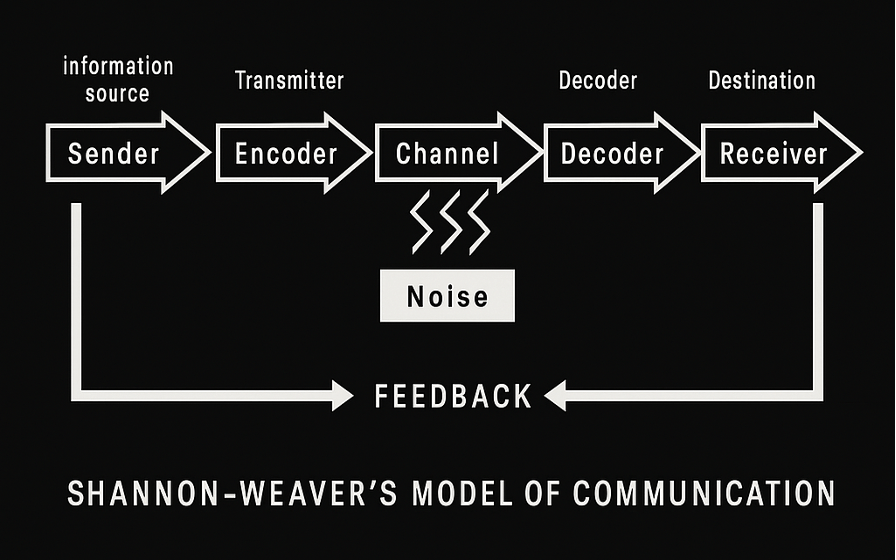
Communication, whether it be for computers or humans, works as a path of information from a sender to a receiver. In the human case, it is the structured movement of meaning between minds. The first challenge is for us to be able to project our thoughts, feelings, and emotions into language— a process which induces some degree of loss inherently. We are, even with a “perfect” vocabulary, limited in our ability to map our complex emotions to words with simple definitions. In person, we can rely on how our emotions manifest through our body to communicate more deeply than words can describe. This is the most effective way humans communicate.
Once the thoughts are imperfectly encoded into words, they are transmitted across space. Here they are subject to noise, meaning a distortion of the communication. In practicality this can be ambient noise, poor phone quality, or typos in writing. It can be more than this though. Disruptive noise can include psychological duress, cultural bias, emotional reactivity, and semantic confusion (vague terms, jargon, or differing definitions). We are up against tremendous barriers in communication.
Clarity is critical, and it starts with intentionality. You must refine the idea to its core in your mind before transmission. Simplicity is a noble goal. Language should be appropriately accessible and free of jargon or excess complexity. Too often writers or speakers will embellish their communication with words or ideas to satisfy their own ego, to display their intelligence or worldliness. This is poor communication because the intention has shifted from clarity to pride. I have been guilty of this.
Communication should follow a structure that is logical, or at least predictable. Consider your audience who has limited time, energy, or interest— we are all similar this way. Make the load easier on your audience, it is the respectful thing to do.
Finally, your communication should be feedback seeking. You must focus that your message is being transmitted and received as intended. This attention to feedback is an act of empathy.
Communication should be engaged with no intent to deceive, harm, or manipulate. Virtuous communication should be rooted in goodwill, and recipients should be treated with respect to their humanity. As Immanuel Kant put it, humans should be regarded as an end in themselves, not as a means to an end.
To willingly withhold communication, especially in the face of conflict, is itself a form of harm. Silence is often used as a strategy in conflict. The strategy is flawed. Though it may give you a machiavellian leverage, by making the other party reasonably desperate for your information, it is still corrosive to the health of the network. This strategy should not be deployed in high stakes situations, or in situations where you genuinely care about a successful outcome.
Network Dynamics and their Human Analogs:
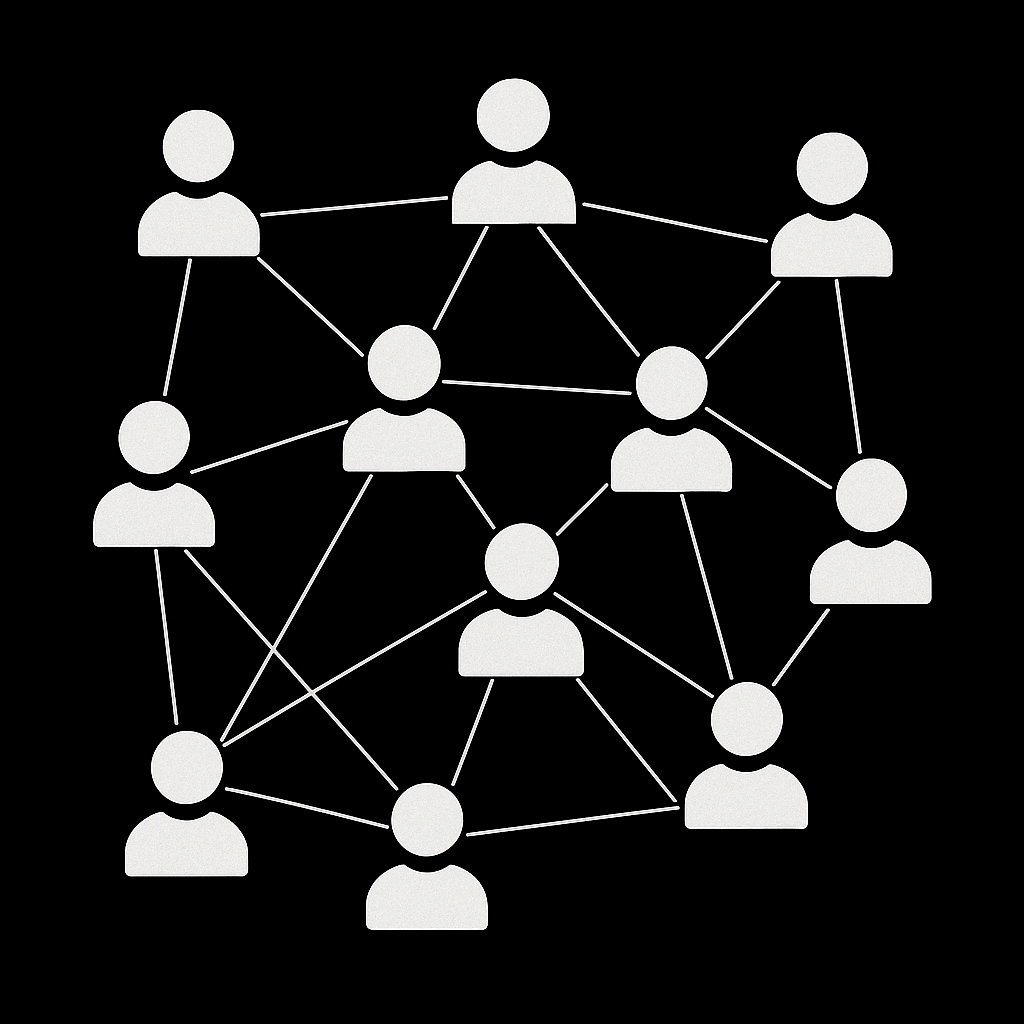
With the emergence of the internet and telecommunication technology, scientists have begun to understand networks as complex systems with their own properties, rules, and dynamics. Reading, understanding, and then abstracting these discoveries can give insights into optimizing our human relationships.
Let’s address the situation of a node that is unresponsive, or uncommunicative. Nodes (people) that are downstream are diminished because of this unresponsiveness. They are not being given information that could be made available to them for appropriate decision making. In this situation, the flow of information will eventually bypass the bad node rendering it obsolete, and neutralizing its damage.
Communication failures are not always malicious, in fact they occur more often from fear, shame, or unexpressed conflict. However, if communicativeness is indeed virtuous, facing these difficulties is worth the challenge.
Beyond the moral imperative, effective communication can also yield economic benefits by positioning yourself within a robust and expansive network. You should be aware that there are incentives to be gained by being a good communicator, and this should further inspire a drive to engage in communication.
There are situations where a single node, perhaps a family member or business founder, is a critical point in the communication network. This structure, while lending some efficiency, makes the network more vulnerable to failure. Decentralizing the network, by empowering multiple voices, keeps the system resilient.
Feedback is also an important aspect of a network. As humans we want to focus on reciprocal communication, rather than broadcasting. In a healthy network, information is shared as a feedback loop which refines its strength and fidelity in the system. Ideas are able to become better developed and more broadly propagated by their refinement in these loops. By only broadcasting, the source node is never changed or adapted, seeding incorrect or destructive information into the system until the nefarious node is eventually discovered and ignored.
Finally, a network is more than the sum of its parts. A brain too is a network of nodes, individual neurons, which has the incredible emergent property of consciousness. Any individual neuron is fairly inconsequential, but its position in a network allows it to perform tasks far beyond its individual capabilities. A neuron receives signal and if a threshold is reached, it fires in an all-or-nothing manner. That’s all it does. However, in conjunction with its network it’s capable of memory, abstraction, and perception. Just like human networks, the brain’s network of neurons is capable of adaption by way of “plasticity”. Plasticity is the basis of learning at the cellular level, by strengthening pathways that are used repeatedly (“Neurons that fire together wire together”) , and pruning connections that are neglected. Even after damage to the brain, or in cases of various disabilities both physical and mental, the brain’s plasticity can find more efficient pathways to regain function.
Communication does not mean incessant talking, there is still value to silence. Incessant broadcasting is a form of noise. Just as a seizure is the uncontrolled firing of neurons— signal without structure, feedback, or purpose— so too is unceasing, unresponsive talking a breakdown of communicative function. It may feel like connection, but in truth, it bypasses empathy and drowns out clarity.
Again, communication should be done with intentionality. Frivolous talk has a place, particularly amongst friends and with levity. However, silence can be a virtue if it prevents the transmission of noise or misunderstanding.
Practical steps to improve communication:
- Turn on read-receipts on your phone. It automatically communicates that a text has been read, which can be useful information for the sender. I can think of very few reasons why you would want to hide that information. An extension of this is simply acknowledging messages, even if you do not have an answer yet– simply communicate that you’ve received the message and you are thinking on it.
- Avoid using silence as a punishment. If you need time or space, say so. Intentionally weaponizing silence is manipulative, and damages connection.
- Use precise language. Avoid using vague language when clear language is needed. Set an exact time and place for a meeting, or communicate your exact intentions.
- There is tremendous utility to politeness and good manners. By being polite you are essentially being proactive with your respect. In return, your conversational partner feels willing to reciprocate. With the many difficulties associated with complex emotional communication, having your partner biased towards giving you the benefit of the doubt is very powerful. Using polite language helps towards this end.
- Be generous in interpretation, particularly over text. Give the benefit of the doubt and assume good intent. Miscommunication is much more common than malice.
- Respond at the pace you would expect from others. Slowness can signal disengagement, and times passing can degrade signal transmission. Match urgency to the context and person.
- Say what you mean, not what you think sounds smart. Simplicity is not “dumbing down”, it’s an impressive skill that provides clarity. Avoid language that performs more than it informs.
- Attempt to end loops that others open. Make a good effort to not “ghost” people in communication. Even a brief reply brings closure to threads and strengthens the signal integrity of the network.
- Own and communicate your mistakes. If you’ve done something that you know is a mistake or is bad, it is better to communicate this mistake than to hide it. This allows your network to adapt to the error faster, and is the first step towards resolution and restoration.
- Feel comfortable putting yourself and your ideas out there. They will be refined by your audience, improving both them and you. Good information should not be kept secret, and bad information must be combated in the open. This can be in conversations with your friends or over social media, which is an extension of that friend network.
- Be comfortable reaching out first. It sometimes feels like the inferior position to be the one reaching out to friends or acquaintances first. Cast away this prideful discomfort with the knowledge that you’re doing a service to the network by extending a connection.
- Say what is true. Use your discretion if truth can cause harm. In those circumstances silence becomes more valuable. However, intentional lying is almost never excusable.
Conclusion:
Ultimately, good communication is not just a soft skill to be tucked into a corner of a resume. It is a power that shapes not just our personal relationships, but the health and resilience of our broader social networks. Practicing clear, empathetic, and responsive communication is more than good advice; it is a moral imperative if we truly value human flourishing.
 Rittenryl