Meaning begins with freedom
I was walking high on the crown of an Aegean caldera, splitting through warm sun and cool sea breeze. I set out to venture from the towns of Oia to Fira, but allowed myself to wander wherever my eyes took me: sapphire vistas, dead ends, over rocks and brambles, and up to the edge of cliffs. I believe I smiled for three hours, even laughing to myself as my path led me through natural beauty and the beautiful ideas of the books I was reading, the friends I missed, and decisions I would soon make.
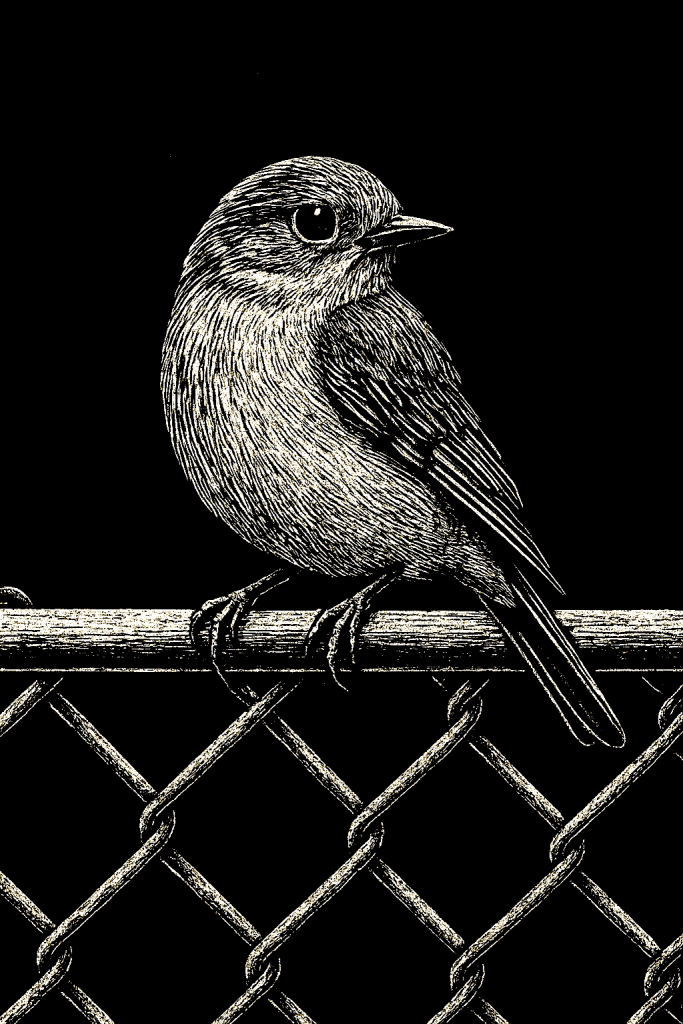
While descending a local peak, I came by a fence on the sea side of the caldera’s edge. Its chain links offended me. A bird rested on the metal post, singing into the crisp morning air. The fence was no barrier to her.
Despite my joy, flowing from the deep sense of freedom I was experiencing, I was, of course, already bound before I came across the fence. I was bound by nature, and by my own nature. I was bound by gravity and the rocks beneath my feet, for which I was grateful. I was bound by my consciousness and perceptions, limited as they are, but sufficient for my enjoyment.
I was also bound by fear. I wouldn’t have dared walk beyond the edge of the trail despite how indigo flowers and iridescent lizards had tempted pursuit. A step towards them slid pebbles cascading down the cliff face, a 300 meter spill. I was content with this limitation too.
But until the fence, I had not felt confinement. The fence was imposed on me, by others; by the will of man.
Farther down the trail, the fence had collapsed from the erosion of the cliff. How apt: the barriers of man are arbitrary and ephemeral. Unlike the bounds of the natural world, which define the world of freedom I seek, the bounds imposed by man are abstract, artificial, and subject to change.
There is no singular meaning of life, but life is not meaningless. Human life is full of meaning, because it is our nature to create it. Whether it be to love, create, learn, pursue virtue, or follow the many idiosyncratic desires that fuel our lives, there is a common prerequisite.
Humans must be free.
My anecdote is a simple metaphor, framed by reflections I had already begun writing. Before that, the theme had emerged in recent conversations. I began seeing confinement everywhere: legal, financial, mental, material, relational, chemical. Those around me were tormented by their prisons, if only they could recognize their cell and address it as such. If only I could…
Some people are literally confined. Slaves and prisoners experience a true restriction in their freedom, and in the extreme we can see its effects more clearly. The slave is stripped of all meaning, and as a result, their humanity. They are not permitted to love or to learn, to pursue any of the true desires of their soul. If they do find purpose it is like a diamond in the desert of their suffering. It may placate or excite them briefly but insufficiently, and they continue to die of thirst, deprived of their ability to imbue and enjoy full meaning. As with the man in the desert, the ultimate purpose for the slave should be freedom. No distraction can be afforded. This becomes the meaning of their life; to reach the bridge to meaning.
An influential book for me was Man’s Search for Meaning by Victor Frankl, and those who have read it can reasonably challenge my claim. In the book, Frankl describes how purpose is critical to survival, and more relevantly, that meaning is not given by circumstances, but discovered or created by the individual.
Those who have a ‘why’ to live, can bear almost any ‘how’
– Victor Frankl
I believe this to be true, and it does not invalidate my claim. Frankl was interned in Auschwitz, effectively a slave sentenced to death in a Nazi concentration camp. However, in these most evil and deprived conditions, he managed a freedom of the mind. A person can choose their attitude, and through that, find meaning. That Frankl found meaning in his hellish environment is a testament to the resilience of the human mind and an indication of the necessity of meaning for human existence. But that he was able to find meaning at all resulted from an incredible inner freedom. Left with no other avenues, Frankl discovered that he could, in the solace of his mind, find liberty. The implications are profound. Frankl would eventually be freed from the physical confines of the concentration camp, and with this additional freedom, continued to pursue his purpose to a higher level – by developing the field of logotherapy and spreading his lessons to the world. The search for meaning should not be thought of as contingent on freedom from physical constraint, but as requiring freedom in some essential form. After all, one must first be free to search.
In fact, the most insidious prisons we are subject to are not always so concrete and obvious. Some people may exist in a prison of the psyche, rapt by fear and anxiety that confines their actions. Is medication a cure, a freedom from psychic shackles, or a palliative from the suffering? Others are trapped by work, tormented by the unceasing stresses of employment but unable to leave. Some are confined by their political environment: allowed to go outside and enjoy the sun, but unable to demonstrate (and therefore even think) critically against the ruling regime. Even a relationship, often the source of the highest human joy, can be a prison as in the case of an abusive partner or damaging familial environment. William Faulkner’s “Barn Burning” depicts such a family environment, and the noble escape of a boy trapped within it.
A prison can take many forms, but they share distinct commonalities; a restriction in freedom, and a barrier to escape.
Search for and think carefully about your prison, it must be recognized consciously because it will torment your subconscious nonetheless.
A trapped lion fights ferociously for its freedom. Only after its will is broken does it submit to confinement. Eventually, it becomes placated by abundant food and cheap entertainment. Its cubs, tragically born into captivity, know even less of what was lost. The prison is their entire world. Despite their ignorant bliss, the lion cub is stunted, unable to develop physically or mentally to the potential offered in their natural environment. It has no conscious memory of an unbounded existence, and yet it is still damaged subconsciously by the anti-natural circumstances of its imprisonment. The lion has been robbed of its nature, stripped of its meaning, subjugated to serving the meaning of its human captors. It is no longer a lion, but the cellular husk of one.
Animals characterized by intelligence and mobility, such as Orcas and Elephants, often begin to deteriorate noticeably in captivity at a zoo, despite access to food and medical technology. Humans are animals of this kind as well.
Though some prisons may be more tolerable than others, what is true for the slave is true for all: you must strive for your freedom. The meaning of life is what guides our behavior, and our behaviors are what compose our life. This life is all we have. To accept tyranny, to allow life to be diminished, should never be acceptable.
This is not to say that we can aspire to be limitless. There are true boundaries to existence which form the framework for our nature. We exist within necessary social boundaries as well, having agreed to the social contract with our society and exchanging freedom for order. This is a worthy transaction. However, the barriers which are formed by mankind — be it external or even internal— that do not serve us fairly have no requirement to exist.
There can be no compromise or placation. Free yourself. If you can see your prison, and notice how it diminishes you, it is your obligation to break free. The escape will not be easy, but the reward will be in proportion to the challenge. To be your true self, filled with soul to the brim, you must first be unbound. From there, from the basis of your true and free nature, you will be able to imbue the manifold meaning of life that awaits you, and enjoy its rewards.
To live a life rich with meaning, we must first be free.
Until then, the meaning of life is freedom.
 Rittenryl